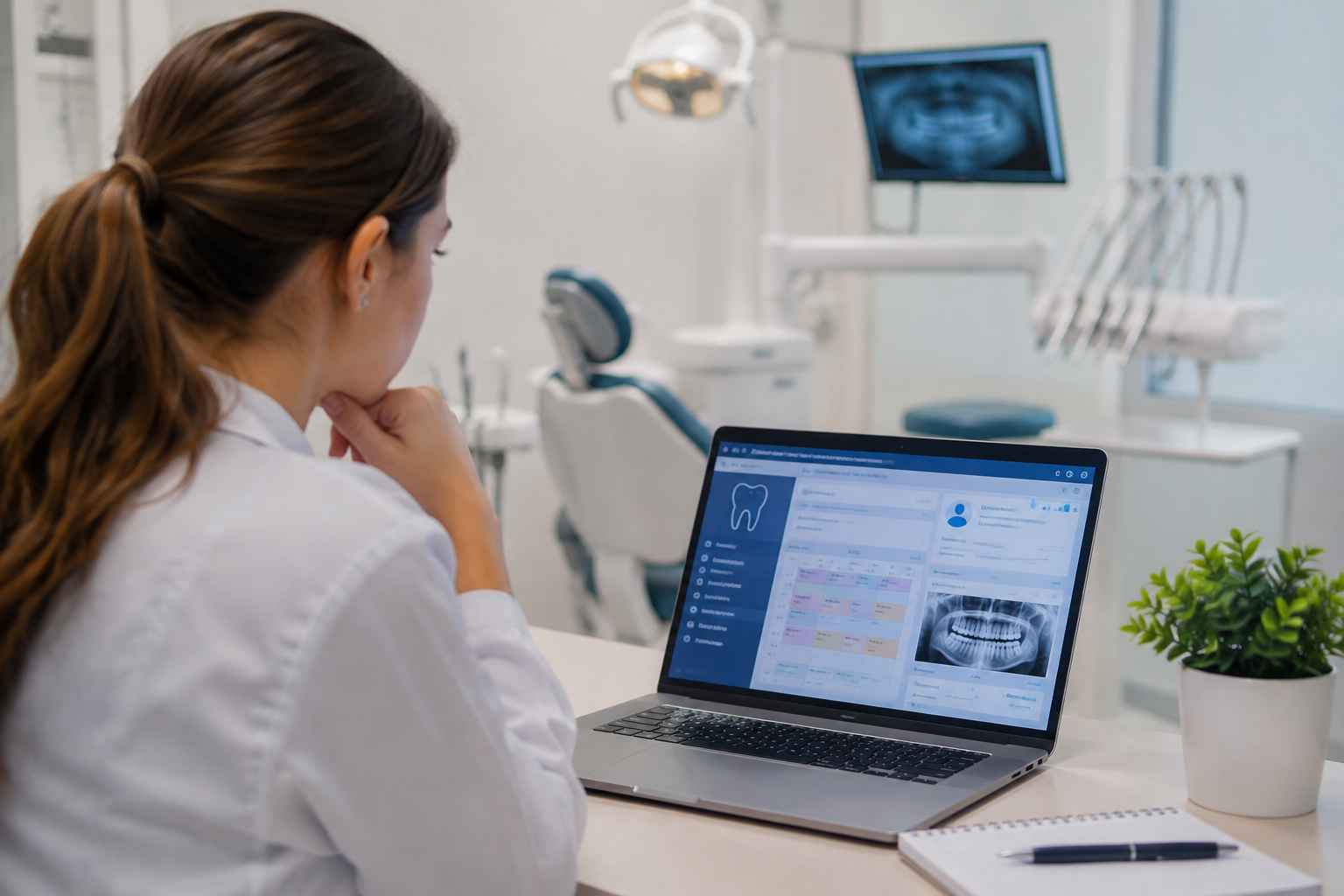
How AI could save a dentist's time on documentation

After every visit a dentist has to write down what was found, what was done and what is planned for next time. This work does not show in the calendar, but it takes a part of the day and often happens after the patient has left. This article looks at what research says about documentation time, what the voice AI assistant we are planning in doktor.al is, and what you can do today to shorten this work.
How much time goes into documentation?
A study published in Annals of Internal Medicine (Sinsky and colleagues, 2016) observed 57 physicians in four specialties in the USA. The authors summarised the result like this: for every hour of direct face time with patients, physicians spent nearly two additional hours on the electronic record and desk work during the clinic day, plus one to two more hours in the evening [1].
We need to be careful with this number. The study was done with ambulatory physicians in the USA, not dentists, and the authors themselves note that the data came from selected practices, so the result does not automatically generalise. It is not a measure for your clinic. It is a signal that documentation can take a much bigger share of time than we assume, and that it is worth measuring yourself.
What the voice AI assistant we are planning is
The idea is simple: the dentist speaks during or right after the visit, for example "occlusal caries on 36, composite filling done, check-up in six months", and the system turns this into a structured note in the patient chart: diagnosis, tooth, treatment, remarks. The dentist reviews it, corrects it and saves it.
We want to be clear about the status: this function is still planned and is not available today. When it is ready it will come at no extra cost for clients. We are not promising a percentage of time saved, because we do not have data from real clinics to say so honestly.
The principles that make it usable
- Always a draft. The AI output is an editable note, not a clinical decision. The dentist verifies it before it is saved. A transcription or interpretation error, such as a mixed-up tooth, has to be caught by a person.
- Structure, not free text. The value is when the note goes into the right fields of the chart (tooth, treatment, diagnosis), not when it stays a long paragraph that cannot be searched later.
- Control over the data. A voice recording and the patient's text are health data. They need the same access restrictions and audit log as any other part of the chart.
Privacy: what to check before using any AI assistant
Health data is a "special category" under the GDPR (Article 9), and the laws of Albania and Kosovo also treat it as sensitive [2][3]. Before you switch on any tool that sends voice or clinical text to an outside processor, ask:
- Where is the data processed and who is the processor?
- Is there a processing agreement with the clinic?
- Is the clinic's data used to train other models?
- Do patients know the note is recorded or processed with AI, and do you have the right privacy notice?
These questions apply to every vendor, not only to us. For more on a clinic's obligations, read the guide to data protection in clinics (in Albanian) and the page on security and GDPR.
What you can do today to shorten documentation
You do not have to wait for AI to save time. Several practices work with any software:
- Record in the chart, not in a notebook. Writing first on paper and then in the system is the most common source of lost time.
- Use the tooth map. Marking a tooth's condition with one click is faster than describing it in words, and easier to search later.
- Link the service to the invoice. When the treatment you record is the same one that is invoiced, you do not retype the work done.
- Standardise repeated phrases. Most check-up visits use the same sentences. A short list agreed by the team saves time and makes the history more consistent.
- Delegate the administrative part. The medical history form, patient details and reminders can be handled by reception, not the dentist.
How to measure the saving in your clinic
Before any change, measure for two weeks: how many minutes a dentist needs to document a check-up visit and a treatment visit, and how many notes are still unwritten at the end of the day. After the change, measure the same things. Only then will you know whether a tool, ours or anyone else's, really helps.
In summary
Documentation is a real time cost and a voice assistant could reduce it, but only if the dentist verifies the result and the data is handled with care. In doktor.al this function is still being planned. If you want to see today how the chart is organised and how it connects to the visit and the invoice, see the dental clinic version or message us for a demo.
Sources
- Sinsky C, Colligan L, Li L, et al. Allocation of Physician Time in Ambulatory Practice: A Time and Motion Study in 4 Specialties. Annals of Internal Medicine, 2016;165(11):753-760.
- Regulation (EU) 2016/679 (GDPR), EUR-Lex: Article 9 (special categories of data, including health data).
- Albania: Law no. 124/2024 "On personal data protection", text published by the Commissioner's office (idp.al). Kosovo: Law no. 06/L-082, supervisory authority Information and Privacy Agency.
This article is general information, not legal or clinical advice. Functions described as "planned" are not available today.